
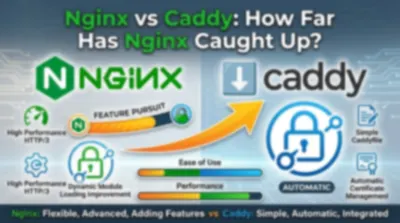
For years, one of the most common reasons to choose Caddy over Nginx was automatic HTTPS.
With Nginx, HTTPS deployments traditionally involved Certbot or another ACME client. Caddy, on the other hand, made automatic HTTPS part of the server's core experience.
But things have changed.
Nginx now has a native ACME module, meaning some of the work that previously required Certbot can now be handled directly by Nginx. That makes the Nginx vs Caddy comparison much more interesting: is Caddy still significantly more modern, or has Nginx caught up?
The answer is not simply "Caddy is newer, Nginx is older."
Today, the two overlap in many capabilities. The bigger difference is in their defaults, level of automation, configuration style, and how much control they expect the administrator to manage explicitly.
Do Nginx and Caddy Basically Do the Same Thing?
At a high level, yes.
Both can function as:
- web servers
- reverse proxies
- TLS termination points
- load balancers
- HTTP/2 and HTTP/3 servers
- gateways for multiple applications
- proxies for internal backends
A simple architecture can look like this:
textInternet │ :80/:443 │ ┌──────┴──────┐ │ │ Nginx Caddy │ │ └──────┬──────┘ │ ┌─────────┼─────────┐ │ │ │ Next.js API Supabase :3000 :8000 internal
So the better question is not:
"What can Caddy do that Nginx cannot?"
A more useful question is:
"How much of it do I have to configure myself?"
That is where their philosophies start to diverge.
Automatic HTTPS: Caddy's Traditional Big Advantage
Traditionally, a typical Nginx HTTPS setup looked something like this:
textNginx
  +
Certbot
  ↓
Let's Encrypt
  ↓
Certificate
  ↓
Renewal
Caddy was designed around a different flow:
textDomain
  ↓
Caddy
  ↓
ACME
  ↓
Certificate
  ↓
Automatic renewal
Caddy makes automatic HTTPS part of its default behavior.
That is why a configuration such as:
caddyfileapi.example.com {
    reverse_proxy localhost:8000
}
can be enough for many simple deployments.
You do not need a long TLS configuration just to put a backend behind HTTPS.
But Nginx Now Has Native ACME
This is the important part.
Nginx now provides ngx_http_acme_module for certificate management through ACMEv2.
With that module, Nginx can handle a flow such as:
textRequest certificate
       ↓
ACME challenge
       ↓
Certificate issued
       ↓
Certificate installed
       ↓
Automatic renewal
So the architecture that used to look like:
textNginx + Certbot
can now become:
textNginx
  +
ngx_http_acme_module
  ↓
Let's Encrypt / ACME
That means the statement:
"Nginx always needs Certbot for automatic HTTPS."
is no longer accurate.
With an Nginx installation that provides and enables the ACME module, Certbot is not required.
There is an important nuance, though: ACME is provided as a module, so its availability and installation method depend on the Nginx version and package you are using.
That differs from Caddy's philosophy, where automatic HTTPS is a central part of the overall user experience.
Example: Nginx + Native ACME
Conceptually, an Nginx configuration can look like this:
nginxacme_issuer letsencrypt {
    uri https://acme-v02.api.letsencrypt.org/directory;
    state_path /var/cache/nginx/acme-letsencrypt;
    accept_terms_of_service;
}

server {
    listen 443 ssl;
    server_name api.example.com;

    acme_certificate letsencrypt;

    ssl_certificate     $acme_certificate;
    ssl_certificate_key $acme_certificate_key;

    location / {
        proxy_pass http://localhost:8000;
    }
}
This is still more explicit than the Caddy example.
Caddy:
caddyfileapi.example.com {
    reverse_proxy localhost:8000
}
Nginx with native ACME:
textACME issuer
+
certificate
+
TLS
+
server
+
reverse proxy
So Nginx has caught up in capability, but it has not changed its underlying character.
Reverse Proxy: Both Are Powerful
For the core reverse-proxy task, there is not a huge difference.
Caddy:
caddyfileapi.example.com {
    reverse_proxy localhost:8000
}
Nginx:
nginxserver {
    listen 443 ssl;
    server_name api.example.com;

    location / {
        proxy_pass http://localhost:8000;
    }
}
Both can route requests from the public internet to an internal application.
The differences become more noticeable when you start dealing with:
- forwarded headers
- timeouts
- buffering
- WebSockets
- caching
- request body limits
- access control
- custom routing
- request/response transformations
Nginx tends to make administrators more explicit about these behaviors.
Caddy tends to provide more useful defaults for common scenarios.
Forwarded Headers
A reverse proxy often needs to preserve information such as:
textX-Forwarded-For
X-Forwarded-Proto
X-Forwarded-Host
The backend may use these to determine:
- the client's IP
- the original protocol
- the original hostname
Caddy has more opinionated proxy behavior around forwarded headers, so simple configurations are often enough.
With Nginx, administrators often add configuration such as:
nginxproxy_set_header Host $host;
proxy_set_header X-Real-IP $remote_addr;
proxy_set_header X-Forwarded-For $proxy_add_x_forwarded_for;
proxy_set_header X-Forwarded-Proto $scheme;
This does not mean Nginx cannot automate it.
The difference is more about how many decisions the server makes for you by default.
HTTP → HTTPS Redirect
Caddy also tries to reduce boilerplate.
When automatic HTTPS is active, HTTP is normally redirected to HTTPS automatically.
With traditional Nginx configuration, you would commonly create a separate server block:
nginxserver {
    listen 80;
    server_name example.com;

    return 301 https://$host$request_uri;
}
Technically, this is trivial.
But when you have many domains, small reductions in repeated configuration can make maintenance noticeably easier.
Load Balancing
Both can do load balancing.
A simple topology is:
textProxy │ ┌────────┼────────┐ │ │ │ App 1 App 2 App 3
Caddy provides load balancing inside reverse_proxy, along with multiple policies and retry/failover behavior.
For example:
caddyfileexample.com {
    reverse_proxy node1:3000 node2:3000 node3:3000
}
Nginx is also very mature in load balancing and supports methods such as round-robin, least-connected, IP hash, weighted balancing, and failure handling.
So load balancing is not an exclusive Caddy advantage.
Health Checks
Caddy can also combine reverse proxying with health checking.
Conceptually:
textCaddy │ ┌───────┼───────┐ │ │ │ node1 node2 node3 │ /health
If a backend becomes unhealthy, the proxy can reduce or stop sending traffic to it according to the configured behavior.
Nginx also has failure handling and various health/load-balancing capabilities, although the exact experience and availability depend on the features, modules, and edition in use.
Again, the difference is less about "can it do this?" and more about how turnkey the feature is.
Dynamic Upstreams and Service Discovery
Caddy is also interesting for modern environments because reverse proxy upstreams can be dynamic, including discovery through DNS.
Conceptually:
textCaddy
  ↓
DNS / service discovery
  ↓
api-1
api-2
api-3
This is useful in containerized systems or environments where backend endpoints can change.
Nginx can also work with dynamic discovery through various mechanisms and modules, but the approach tends to be more explicit and distributed across different features.
Dynamic Configuration and APIs
This is another important difference.
Caddy supports native JSON configuration and an API.
That means another system can programmatically change Caddy's configuration.
For example:
textControl Panel
      ↓
Caddy API
      ↓
Create route
      ↓
HTTPS
      ↓
Reverse proxy
This is especially interesting for multi-tenant systems.
For example:
textUser creates tenant
       ↓
tenant.example.com
       ↓
route created
       ↓
backend mapped
       ↓
HTTPS active
With a traditional Nginx workflow, the process is often closer to:
textEdit configuration
       ↓
Validate
       ↓
Reload Nginx
Nginx certainly has an ecosystem for dynamic configuration, but Caddy more clearly embraces API-first configuration as part of its architecture.
Compression: Not a Major Differentiator
Compression is not a strong reason to choose Caddy.
Nginx has supported gzip and other compression options for a long time.
Caddy supports compression as well.
So this is not really a case of one replacing the other.
Both are mature enough for common use cases.
HTTP/2 and HTTP/3: No Longer a Strong Differentiator
HTTP/2 and HTTP/3 also cannot be used as a simple argument that Caddy is much more modern.
Nginx supports these technologies too.
So choosing Caddy simply because:
"Caddy supports HTTP/3."
is no longer a sufficient argument.
So What Is Caddy's Real Advantage?
Once we remove the features both products already share, Caddy's advantages become more specific.
1. Simplicity
A configuration like:
caddyfileapi.example.com {
    reverse_proxy localhost:8000
}
is very short while still representing a fairly complete deployment.
Caddy tries to make common configurations easy for humans to read and maintain.
2. Secure Defaults
Caddy generally prefers safe and modern behavior by default.
The administrator does not always have to specify every detail manually.
3. Automation as a Core Concept
Automatic HTTPS is not just an add-on feature.
Automation is a major part of the Caddy experience.
4. Dynamic and API-Driven Configuration
Caddy is well suited to systems that need configuration changes programmatically.
That is useful for:
- multi-tenant applications
- containerized infrastructure
- internal platforms
- automation pipelines
Why Is Nginx Still So Popular?
Because Nginx's advantage is not simply "it has more features."
Nginx has:
- a huge ecosystem
- an enormous amount of documentation and tutorials
- years of production experience
- integrations with many infrastructure tools
- highly granular configuration
- a very large community of administrators already familiar with it
If a company already operates hundreds or thousands of Nginx servers, migrating to Caddy just to reduce configuration size may not provide enough benefit to justify the change.
There is also a difference in philosophy:
textCaddy
  ↓
"Give me the domain and backend."

Nginx
  ↓
"Give me the exact rules."
Both approaches are valid.
Nginx vs Caddy Today
A more realistic comparison looks like this:
| Feature | Caddy | Nginx |
|---|---|---|
| Reverse proxy | ✅ | ✅ |
| Load balancing | ✅ | ✅ |
| Health checking | ✅ | ✅ |
| TLS | ✅ | ✅ |
| ACME | ✅ built-in | ✅ native module |
| Automatic renewal | ✅ | ✅ with ACME module |
| HTTP → HTTPS automatic | ✅ | ⚠️ usually configured |
| Forwarded headers | ✅ more automatic | ⚠️ often explicit |
| Dynamic upstreams | ✅ | ✅ with specific approaches/modules |
| API-driven configuration | ✅ | ⚠️ more complex |
| HTTP/2 | ✅ | ✅ |
| HTTP/3 | ✅ | ✅ |
| Fine-grained control | ⭐⭐⭐⭐ | ⭐⭐⭐⭐⭐ |
| Simplicity | ⭐⭐⭐⭐⭐ | ⭐⭐⭐ |
| Ecosystem/maturity | ⭐⭐⭐ | ⭐⭐⭐⭐⭐ |
The star ratings are not performance benchmarks. They are only a quick way to describe the general character and configuration experience.
Has Nginx Caught Up with Caddy?
In several important areas, yes.
The clearest example is ACME.
Before:
textNginx
  +
Certbot
Now:
textNginx
  +
ngx_http_acme_module
Nginx also has strong support for modern protocols such as HTTP/3, along with mature reverse-proxy and load-balancing capabilities.
But Nginx has not become Caddy.
And it does not need to.
Nginx remains focused on control and flexibility, while Caddy focuses more heavily on sensible defaults and automation.
Which One Makes More Sense for a Modern VPS?
Suppose you have:
textInternet │ HTTPS │ Caddy │ ┌──────────────┼──────────────┐ │ │ │ Next.js Supabase Admin :3000 internal :xxxx
For a single VPS running several applications, Caddy is attractive because the ingress layer can remain very small.
For example:
caddyfilewww.example.com {
    reverse_proxy localhost:3000
}

api.example.com {
    reverse_proxy localhost:8000
}

admin.example.com {
    reverse_proxy localhost:9000
}
Caddy handles the part we generally want to minimize:
textHTTPS
certificate
renewal
routing
reverse proxy
while the applications remain focused on:
textNext.js
API
Supabase
Database
However, if you already have a strong Nginx standard, need highly granular configuration, or want to take advantage of its mature ecosystem, Nginx remains an excellent choice.
Conclusion
Caddy is not simply "a newer version of Nginx."
The two now overlap heavily in functionality.
The more accurate distinction is:
textCADDY │ Secure defaults │ ┌───────────┼───────────┐ │ │ │ HTTPS Proxy Routing automatic simple easy NGINX │ Maximum control │ ┌───────────┼───────────┐ │ │ │ TLS Proxy Routing │ │ │ ACME modules config
And one important point needs to be updated compared with older comparisons:
"Caddy has automatic HTTPS, while Nginx needs Certbot."
That is no longer an accurate description.
With its native ACME module, Nginx can now manage certificates automatically without Certbot.
So in 2026, the more useful question is:
Do you want a server that makes more decisions automatically, or a server that gives you more explicit control?
For a personal VPS or a modern application running several services, Caddy is often more convenient.
For infrastructure that requires granular control and a deeply established ecosystem, Nginx remains extremely difficult to beat.